Saturday, 19 October 2013

Dealing with static methods in unit tests

This is a follow up post to my previous one on adding tests to legacy code, and shows several techniques for removing a dependency on a call to a static method. Once again, I make no apologies for the state of the resulting code; these techniques are each a pragmatic step towards getting legacy code under test so it can be refactored.

The code to test

The class to write tests for is intentionally simple; it has a single method that takes a string which is used to look up a value in a file, and modifies that string before returning it. Because of the dependency on a file, the code doesn't run from a unit test without that file being present.
public class Builder
{
    public string BuildString(string configName)
    {
        var retVal = ConfigReader.GetConfig(configName);
        return "xx" + retVal + "xx";
    }
}
The ConfigReader class also has a single method, that reads a value from a custom configuration file:
public class ConfigReader
{
    public static string GetConfig(string setting)
    {
        using (var reader = File.OpenText("..\app.config"))
        {
            string line;
            while ((line = reader.ReadLine()) != null)
            {
                var elements = line.Split('=');
                if (elements[0] == setting)
                {
                    return elements[1];
                }
            }
        }
        return null;
    }
}

Add virtual method

This is the technique that I highlighted in my original post. It involves creating a virtual method in the class under test, which in a production setting will delegate the call to the existing static method. In a test scenario though, it allows the class under test to be subclassed, and override the virtual method to return a dummy result.

Notes

  • This technique can only be used when the class under test is not sealed
  • It requires no changes to the static class

Steps to implement:

Class under test
  1. Add a virtual method
  2. Delegate the call to the static method to the new virtual method
  3. Update calls to the static method to call the new method
public class Builder
{
    public string BuildString(string configName)
    {
        // 3
        var retVal = GetConfig(configName);
        return "xx" + retVal + "xx";
    }

    // 1
    protected virtual string GetConfig(string configName)
    {
        // 2
        return ConfigReader.GetConfig(configName);
    }
}
Test class
  1. Create a subclass of the class under test
  2. Override the virtual method to return a known result
  3. Create an instance of the subclass as the test target
[TestFixture]
public class BuilderTests
{
    [Test]
    public void BuildString()
    {
        // 3
        var target = new FakeBuilder();
        Assert.That(target.BuildString(""), Is.EqualTo("xxExpectedxx"));
    }

    // 1
    private class FakeBuilder : Builder
    {
        // 2
        protected override string GetConfig(string configName)
        {
            return "Expected";
        }
    }
}

Delegate to instance method

This technique involves adding an instance method to the dependency class, and extracting its interface. A stub of this interface can then be passed to the class for testing.

Notes

  • This technique can only be used when the dependency class is not marked static

Steps to implement:

Dependency class
  1. Add an instance method
  2. Delegate from the instance method to static method
  3. Extract the interface
  4. Implement the interface
// 3
public interface IConfigReader
{
    string GetConfiguration(string setting);
}

//4
public class ConfigReader : IConfigReader
{
    // 1
    public string GetConfiguration(string setting)
    {
        // 2
        return GetConfig(setting);
    }

    public static string GetConfig(string setting)
    {
        using (var reader = File.OpenText("..\app.config"))
        {
            string line;
            while ((line = reader.ReadLine()) != null)
            {
                var elements = line.Split('=');
                if (elements[0] == setting)
                {
                    return elements[1];
                }
            }
        }
        return null;
    }
}
Class under test
  1. Add a new constructor to accept an implementation of the interface
  2. Update existing constructor(s) to create default implementation
  3. Update calls to static method to call interface method
public sealed class Builder
{
    private IConfigReader configReader;

    // 2
    public Builder()
        : this(new ConfigReader())
    { }

    // 1
    internal Builder(IConfigReader ConfigReader)
    {
        this.configReader = ConfigReader;
    }

    public string BuildString(string configName)
    {
        // 3
        var retVal = configReader.GetConfiguration(configName);
        return "xx" + retVal + "xx";
    }
}
Test class
  1. Stub the new interface
  2. Pass the stub to the new constructor
[TestFixture]
public class BuilderTests
{
    [Test]
    public void BuildString()
    {
        // 1
        var configFileReader = MockRepository.GenerateMock<IConfigReader>();
        configFileReader.Stub(fr => fr.GetConfiguration(Arg<string>.Is.Anything))
            .Return("Expected");

        //2
        var target = new Builder(configFileReader);
        Assert.That(target.BuildString(""), Is.EqualTo("xxExpectedxx"));
    }
}

Wrap static class

This technique is to create an instance class that delegates calls to the static class, but allows an interface to be specified for the calling class to use.

Notes

  • This technique does not require any change to the dependency class

Steps to implement:

Wrapper class
  1. Create a new class with an instance method
  2. Delegate from the instance method to the static methods
  3. Extract the interface of the new class
// 3
public interface IConfigReaderWrapper
{
    string GetConfig(string setting);
}

// 1
public class ConfigReaderWrapper : IConfigReaderWrapper
{
    // 2
    public string GetConfig(string setting)
    {
        return ConfigReader.GetConfig(setting);
    }
}
Class under test
  1. Add a new constructor to accept an implementation of the new interface
  2. Update existing constructor(s) to create the default implementation
  3. Change all static method calls to call instance methods on the new interface
public class Builder
{
    private IConfigReaderWrapper configReader;

    // 2
    public Builder()
        : this(new ConfigReaderWrapper())
    { }

    // 1
    internal Builder(IConfigReaderWrapper ConfigReader)
    {
        this.configReader = ConfigReader;
    }

    public string BuildString(string configName)
    {
        // 3
        var retVal = configReader.GetConfig(configName);
        return "xx" + retVal + "xx";
    }
}
Test class
  1. Stub the new interface
  2. Pass to stub to new constructor
[TestFixture]
public class BuilderTests
{
    [Test]
    public void BuildString()
    {
        // 1
        var configFileReader = MockRepository.GenerateMock<IConfigReaderWrapper>();
        configFileReader.Stub(fr => fr.GetConfig(Arg<string>.Is.Anything))
            .Return("Expected");

        // 2
        var target = new Builder(configFileReader);
        Assert.That(target.BuildString(""), Is.EqualTo("xxExpectedxx"));
    }
}

Pass lambda as implementation of static method

This technnique is to use a property on the static class to hold the implementation of the static method, and pass a fake implementation for testing.

Notes

  • Does not need changes to the class under test

Steps to implement:

Static class
  1. Extract the implementation of the static method to a private static method
  2. Add a static property to hold a lambda whose signature matches that of the private method
  3. Add a static constructor
  4. Default the lambda to call the private method
  5. Modify the static method to execute the lambda held in the property
public static class ConfigReader
{
    // 2
    internal static Func<stringstring> getConfigImpl { get; set; }

    // 3
    static ConfigReader()
    {
        // 4
        getConfigImpl = s => _GetConfig(s);
    }

    public static string GetConfig(string setting)
    {
        // 5
        return getConfigImpl(setting);
    }

    // 1
    private static string _GetConfig(string setting)
    {
        using (var reader = File.OpenText("..\app.config"))
        {
            string line;
            while ((line = reader.ReadLine()) != null)
            {
                var elements = line.Split('=');
                if (elements[0] == setting)
                {
                    return elements[1];
                }
            }
        }
        return null;
    }
}
Test class
  1. Set the new property on the static class to the fake implementation
[TestFixture]
public class BuilderTests
{
    [Test]
    public void BuildString()
    {
        // 1
        ConfigReader.getConfigImpl = s => "Expected";
        
        var target = new Builder();
        Assert.That(target.BuildString(""), Is.EqualTo("xxExpectedxx"));
    }
}

Any more?

One other technique is to use an advanced mocking framework that can stub static methods; unfortunately none of the free ones I know have this feature.

Can you think of any other techniques that I haven't covered? If so, please leave a comment and let me know.

The code for these examples is on GitHub, click here.

Sunday, 13 October 2013

Refactoring legacy code to add tests

Imagine you have some legacy code in your product. Code that's been added to over the years by several different developers, none of who were certain they understood the code. There is no separation of concerns; the code has business logic and database access baked in. There's no useful documentation and the code comments are no more than sarcastic outbursts of cynicism.

A bug report has come in that suggests some of the SQL being executed from this method is invalid. So, what's the plan? Hack the SQL construction around until it feels like it does what you want, hoping you haven't broken anything else in the class? Or take a more structured approach?

To illustrate the problem, I have written some legacy-style code so I can show how to refactor it to make it testable. The techniques here are a pragmatic approach to getting legacy code under test, while making as few untested changes as necessary. Because as you will already know, a class is only able to be refactored when it's under test.

The code for the class is available on GitHub here, and looks like this
using System.Collections;

namespace CombinationOfConcerns
{
    public class Data
    {
        private readonly string _type;

        public Data(string type)
        {
            _type = type;
        }

        public ArrayList GetData(string code, string gdr, string filterType, bool getAge)
        {
            ArrayList results = null;

            var sql = "select id from people where type = " + _type + " and gender ='" + gdr + "'";
            string values = DatabaseWrapper.GetSingleResult(sql);
            for (int i = 0; i < values.Split(',').Length; i++)
            {
                switch (code)
                {
                    case "128855":
                        sql = "select name";
                        if (getAge)
                            sql += ",age";                    
                        sql += ",gender from people where type in(" + values + ")";
                        if (filterType == "45")
                        {
                            sql += " and gender='" + gdr + "'";
                        }
                        if (filterType == "87")
                        {
                            sql += " and shoesize = 43";
                        }
                        results = DatabaseWrapper.GetManyResults(sql);
                        break;
                    case "1493":
                        sql = "select dogs.name, dogbreeds.breed from";
                        sql += " dogs inner join dogbreeds on";
                        sql += " dogs.breed = breed.breed where dogs.ownerId in(" + values + ")";
                        if (filterType == "12")
                        {
                            sql += " and coat='curly'";
                        }
                        results = DatabaseWrapper.GetManyResults(sql);
                        break;
                    default:
                        sql = "select name, population from countries,people on where people.countryname = countries.name and people.id in(" + values + ")";
                        if (filterType == "f")
                        {
                            sql += " and countries.continent='South America'";
                        }
                        if (filterType == "642")
                        {
                            sql += " and countries.continent='Europe'";
                        }
                        results = DatabaseWrapper.GetManyResults(sql);
                        break;
                }
            }
            return results;
        }
    }
}

Run the code

Some great advice from Michael Feathers goes something like this: "if you need to see what some code does, run it." In practice, this means write a test that exercises the code, and see how far it gets without failing. If it doesn't fail, that route through the code has no dependencies and will be easier to write tests for. If it does fail, it will highlight dependencies that need to be abstracted.

To run some code, the first job is to find a suitable entry point to the method. If the method to test is public or internal, that's the entry point. If not, is the method called from a public or internal method? If not, the method should be made internal to allow it to be called directly.

The method on the Data class that needs testing is the public GetData method. Here's the first test:
        [TestFixture]
        public class GetData
        {
            [Test]
            public void WithEmptyArgs()
            {
                var target = new Data("");
                target.GetData("", "", "", false);
            }
        }
When this runs, the GetData method fails on a call to the DatabaseWrapper class, showing that there's a dependency on that class that needs to be faked for testing.
        public ArrayList GetData(string code, string gdr, string filterType, bool getAge)
        {
            ArrayList results = null;

            var sql = "select id from people where type = " + _type + " and gender ='" + gdr + "'";
            string values = DatabaseWrapper.GetSingleResult(sql);
            //Code fails in call to GetSingleResult

Deal with dependencies

If the DatabaseWrapper class was an instance, the best way to deal with it would be to extract its interface and use that interface through the code, allowing a stub to be used from a test. However, in this example DatabaseWrapper is a static class, so needs to be dealt with in a different way.

One way would be to add an instance wrapper class around the static class (DatabaseWrapperWrapper..?). This would call the static method from within that class's instance methods, and allow an interface to be used in the GetData method.

Another way is to add a protected virtual method in the Data class that wraps the static method; this allows the test code to use a subclass of the Data class, and override the virtual method. I'll demonstrate that. Here's the new virtual method and its usage in the GetData method:
        protected virtual string GetSingleResult(string sql)
        {
            return DatabaseWrapper.GetSingleResult(sql);
        }

        public ArrayList GetData(string code, string gdr, string filterType, bool getAge)
        {
            ArrayList results = null;

            var sql = "select id from people where type = " + _type + " and gender ='" + gdr + "'";

            //Now calls virtual method
            string values = GetSingleResult(sql);

and here's the usage in the test project. There's a new class, FakeData, that extends Data. This has an override of the virtual GetSingleResult method, returning an empty string for now. Note that the FakeData class is the new target for the test.
        [TestFixture]
        public class GetData
        {
            [Test]
            public void WithEmptyArgs()
            {
                var target = new FakeData("");
                target.GetData("", "", "", false);
            }

            private class FakeData : Data
            {
                public FakeData(string type)
                    : base(type)
                { }

                protected override string GetSingleResult(string sql)
                {
                    return "";
                }
            }
        }
The code under test now runs up to the call to DatabaseWrapper.GetManyResults, so the GetManyResults method needs a virtual wrapper the same as GetSingleResult did:
        protected virtual ArrayList GetManyResults(string sql)
        {
            return DatabaseWrapper.GetManyResults(sql);
        }
the calls to DatabaseWrapper.GetManyResults need to be changed to the local GetManyResults:
...
    default:
        sql = "select name, population from countries,people on where people.countryname = countries.name and people.id in(" + values + ")";
        if (filterType == "f")
        {
            sql += " and countries.continent='South America'";
        }
        if (filterType == "642")
        {
            sql += " and countries.continent='Europe'";
        }

        // Now calls the virtual method
        results = GetManyResults(sql);
        break;
...
and the FakeData class in the tests needs to override the method:
            private class FakeData : Data
            {
                public FakeData(string type)
                    : base(type)
                { }

                protected override string GetSingleResult(string sql)
                {
                    return "";
                }

                protected override ArrayList GetManyResults(string sql)
                {
                    return new ArrayList();
                }
            }
Now there's a test that mocks a call to the database, and runs through the method from start to finish. But because of the many responsibilities of the code, what needs to be asserted - the SQL that is being executed on the database - is not exposed outside the GetData method.

Sensing variables

In order to see the value of the SQL being executed, the test class will use a "sensing variable". This is a variable that stores a runtime value so that it is available for a test to perform an assertion on. In this example, the sensing variable will be on the FakeData class, and will store the value of the SQL string passed to the GetManyResults method.
        [TestFixture]
        public class GetData
        {
            [Test]
            public void WithEmptyArgs()
            {
                var target = new FakeData("");
                target.GetData("", "", "", false);
                // Use the sensing variable in the assertion
                Assert.That(target.ExecutedSql, Is.EqualTo(""));
            }

            private class FakeData : Data
            {
                // The sensing variable
                public string ExecutedSql { get; private set; }

                public FakeData(string type)
                    : base(type)
                { }

                protected override string GetSingleResult(string sql)
                {
                    return "";
                }

                protected override ArrayList GetManyResults(string sql)
                {
                    //Store the value in the sensing variable
                    ExecutedSql = sql;
                    return new ArrayList();
                }
            }
        }
A well-placed breakpoint allows the sensing variable's value to be harvested, and used as the expected result for that test.

            [Test]
            public void WithEmptyArgs()
            {
                var target = new FakeData("");
                target.GetData("", "", "", false);
                
                const string expected = "select name, population "
                    + "from countries,people on where people.countryname = "
                    + "countries.name and people.id in()";
                
                Assert.That(target.ExecutedSql, Is.EqualTo(expected));
            }
Which gives the first green test!

Although this single test is not particularly useful, the journey to get to it has shown some techniques that are available when tackling legacy code. In future posts I'll write more tests and get to a point where it's safe to refactor the code. The I'll refactor the hell out of it.

In Summary

  1. Run the code
    • Identify the start point
    • Make method visible (public/internal)
    • Write a test to exercise the code
  2. Deal with dependencies
    • Introduce interface for instance class
    • Wrap a static class in an instance class
    • Create virtual method to hide static method calls
  3. Sensing variables
    • Use to surface runtime values


If there are other techniques that you employ to refactor legacy code, I'd like to know what they are - they are all useful.

The before and after code used in this example is on GitHub at orangutanboy/LegacyCodeUnderTest

Wednesday, 2 October 2013

Open a command prompt in the current directory

Type "cmd" in the address bar

This has been blogged elsewhere, but I was *so* amazed to see this that I needed to share it. All credit goes to Tom (@photomoose) for doing this while I was watching.


If you have Windows Explorer open and need a command prompt in that directory:

Go to the address bar, remove the directory name and enter "cmd"


Press enter, and voilà, your command prompt, initialised to the current directory.


Shift-Right Click

Thanks to John (@imaji) for this tip.

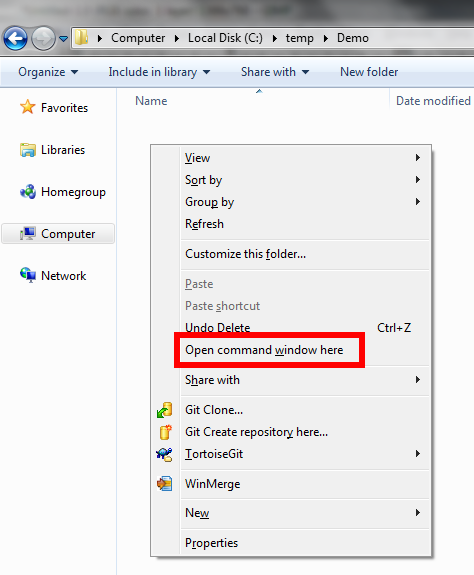
If you hold Shift and right-click in Windows Explorer, you get an item added on the popup menu. The non-shift version looks like this:


But with shift held down, you get this:


Monday, 30 September 2013

What I Learnt About .Net Custom Formatters

I recently needed to format a DateTime object to a custom format, this post is a dump of what I learnt. It shows the steps necessary to implement a formatter that returns the name of the date's weekday. (This wasn't the custom format I needed to implement, it's just an example).

There are 2 components to formatting, a FormatProvider and a CustomFormatter - the FormatProvider's task is to serve up an instance of a CustomFormatter.

First, the FormatProvider:
    public class WeekdayFormatProvider : IFormatProvider
    {
        public object GetFormat(Type formatType)
        {
            throw new NotImplementedException();
        }
    }
Next, the CustomFormatter:
    public class WeekdayFormatter : ICustomFormatter
    {
        public string Format(string format, object arg, IFormatProvider formatProvider)
        {
            throw new NotImplementedException();
        }
    }
IFormatProvider.GetFormat() is called from within the string.Format method. The formatType argument is the type of CustomFormatter required; the convention is, if you can provide a formatter of that type, then return one, otherwise return null.
    public class WeekdayFormatProvider : IFormatProvider
    {
        public object GetFormat(Type formatType)
        {
            if (formatType == typeof(ICustomFormatter))
            {
                return new WeekdayFormatter();
            }
            return null;
        }
    }
The type of formatter required will change depending on the method used to invoke the FormatProvider. For example, the DateTime.ToString(IFormatProvider) method will request a formatter of type DateTimeFormatInfo. As this class is sealed, it's not possible to derive from it. So in order to use a custom formatter with a DateTime, you need to use a string.Format(IFormatProvider...) overload.

ICustomFormatter.Format() is also called from the string.Format method. It should return the formatted string for the required object (passed to the method via the arg parameter). For this example it just needs to calculate the day name and reverse it.
    public class WeekdayFormatter : ICustomFormatter
    {
        public string Format(string format, object arg, IFormatProvider formatProvider)
        {
            var dayName = ((DateTime)arg).DayOfWeek.ToString();
            return new string(dayName.Reverse().ToArray());
        }
    }
The format parameter is used to pass the formatString component of a format item.
So, for the usage
    string.Format(new WeekdayFormatProvider(), "{0:R}", DateTime.MinValue);
the arguments would be
    format : "R"
    arg : [DateTime.MinValue]
    formatProvider : WeekdayFormatProvider
The following shows how this format string could be used. The formatter is going to inspect the value passed; if it's "R" then reverse the weekday, otherwise return the weekday in the more usual format.
    public class WeekdayFormatter : ICustomFormatter
    {
        public string Format(string format, object arg, IFormatProvider formatProvider)
        {
            var dayName = ((DateTime)arg).DayOfWeek.ToString();
            if (format == "R")
            {
                return new string(dayName.Reverse().ToArray());
            }
            return dayName;
        }
    }
Another convention, in the Format() method, is to handle arguments that are not specifically of the type expected. The pattern is shown in this, the final version of the formatter:
    public class WeekdayFormatter : ICustomFormatter
    {
        public string Format(string format, object arg, IFormatProvider formatProvider)
        {
            try
            {
                var dayName = ((DateTime)arg).DayOfWeek.ToString();
                if (format == "R")
                {
                    return new string(dayName.Reverse().ToArray());
                }
                return dayName;
            }
            catch (InvalidCastException)
            {
                if (arg is IFormattable)
                {
                    return ((IFormattable)arg).ToString(format, CultureInfo.CurrentCulture);
                }
                else if (arg != null)
                {
                    return arg.ToString();
                }
                else
                {
                    return String.Empty;
                }
            }
        }
    }
Putting it all together, this usage:
        static void Main(string[] args)
        {
            var formatProvider = new WeekdayFormatProvider();
            
            var formattedMinDate = string.Format(formatProvider, "{0}", DateTime.MinValue);
            Console.WriteLine(formattedMinDate);
            
            var formattedMinDateReversed = string.Format(formatProvider, "{0:R}", DateTime.MinValue);
            Console.WriteLine(formattedMinDateReversed);

            var formattedInteger = string.Format(formatProvider, "{0:R} {1}", DateTime.MinValue, int.MaxValue);
            Console.WriteLine(formattedInteger);
            
            Console.ReadLine();
        }
gives this output:
Monday
yadnoM
yadnoM 2147483647
The final code used is available on GitHub at https://github.com/orangutanboy/CustomFormatter/

Saturday, 27 July 2013

Visual Studio's Make Object ID

Ever wished you could watch the value of an out-of-scope variable while debugging in Visual Studio? You can, if you use the Make Object ID option in the watch/local window. Here's an example, with a variable p that goes out of scope when control jumps to a new method, or back to the calling method:
class Person
{
    public Person(string name)
    {
        Name = name;
    }
    public string Name { get; set; }
}

public class Program
{
    public static void Main(string[] args)
    {
        DoIt();
    }

    private static void DoIt()
    {
        var p = new Person("Baldrick");
        DoIt2();
    }

    private static void DoIt2()
    {
        return;
    }
}
If you step through this code in Visual Studio and add a watch to variable p in method DoIt, the watch window will look like this:


When you step into method DoIt2, or out to Main, and refresh the watch on p, you get this message in the watch window:


If you want to be able to reliably watch the variable, the solution is to Make Object ID. Let's take the code back to DoIt and right-click on the watch on variable p:

Click on Make Object ID, and you'll see variable p is allocated object ID "1#"

If you add a watch to 1#, this allows you to view the value of p even when p goes out of scope:

The 1# reference can be used to update the value of the underlying variable p:

which will be reflected when (if) the object comes back into scope:


What about Garbage Collection?

The Object ID doesn't create a managed reference to the underlying object, which means that it will not interfere with its garbage collection:


Sunday, 21 July 2013

How to post an HTTP form with .Net Micro Framework

This snippet of code shows how to use the .Net Micro Framework to create a representation of an HTTP form, and post it to a URL:
        public void PostNameValues(string value1, string value2)
        {
            // Create the form values
            var formValues = "name1=" + value1 + "&name2=" + value2;

            // Create POST content
            var content = Gadgeteer.Networking.POSTContent.CreateTextBasedContent(formValues);

            // Create the request
            var request = Gadgeteer.Networking.HttpHelper.CreateHttpPostRequest(
                @"http://www.mjonesweb.co.uk/api/values" // the URL to post to
                , content // the form values
                , "application/x-www-form-urlencoded" // the mime type for an HTTP form
            );

            // Post the form
            request.SendRequest();
        }

Sunday, 7 July 2013

Accessing the web with Gadgeteer ethernet module

I've discovered just how easy it is to use the Gadgeteer Ethernet J11D module from GHI Electronics to retrieve resources from the web. As ever, here's the project designer:

As for the code, it can be summed up in 3 steps:

  1. Get/supply an IP address
  2. Send a HTTP request to the URI
  3. Handle the HTTP response

using Gadgeteer.Networking;
using NetworkModule = Gadgeteer.Modules.Module.NetworkModule;
using Gadgeteer;

namespace Demo
{
    public partial class Program
    {
        void ProgramStarted()
        {
            //The other option is UseStaticIP
            ethernet.UseDHCP();

            //Set a handler for when the network is available
            ethernet.NetworkUp += ethernet_NetworkUp;
        }

        void ethernet_NetworkUp(NetworkModule sender, NetworkModule.NetworkState state)
        {
            //Set the URI for the resource
            var url = "http://i1072.photobucket.com/albums/w367/"
                + "M_J_O_N_E_S/MeGadgeteerSize_zps23202046.jpg?t=1373144748";

            //Create a web request
            var request = WebClient.GetFromWeb(url);

            //This is async, so set the 
            //handler for when the response received
            request.ResponseReceived += request_ResponseReceived;

            //Send the request
            request.SendRequest();
        }

        void request_ResponseReceived(HttpRequest sender, HttpResponse response)
        {
            if (response.StatusCode == "200")
            {
                //This only works if the bitmap is the 
                //same size as the screen it's flushing to
                response.Picture.MakeBitmap().Flush();
            }
            else
            {
                //Show a helpful error message
                lcd.SimpleGraphics.DisplayText("Request failed with status code " + response.StatusCode
                    , Resources.GetFont(Resources.FontResources.NinaB), Color.White, 0, 0);

                lcd.SimpleGraphics.DisplayText("Response text: " + response.Text
                       , Resources.GetFont(Resources.FontResources.NinaB), Color.White, 0, 50);

            }
        }
    }
}

Here's the result of the code:

And an example of when things don't go according to plan:

The web request can't only be used to download picture resources; if you request a run-of-the-mill HTML page, you are able to access the streamed response:


The code for this demo is available here on GitHub